
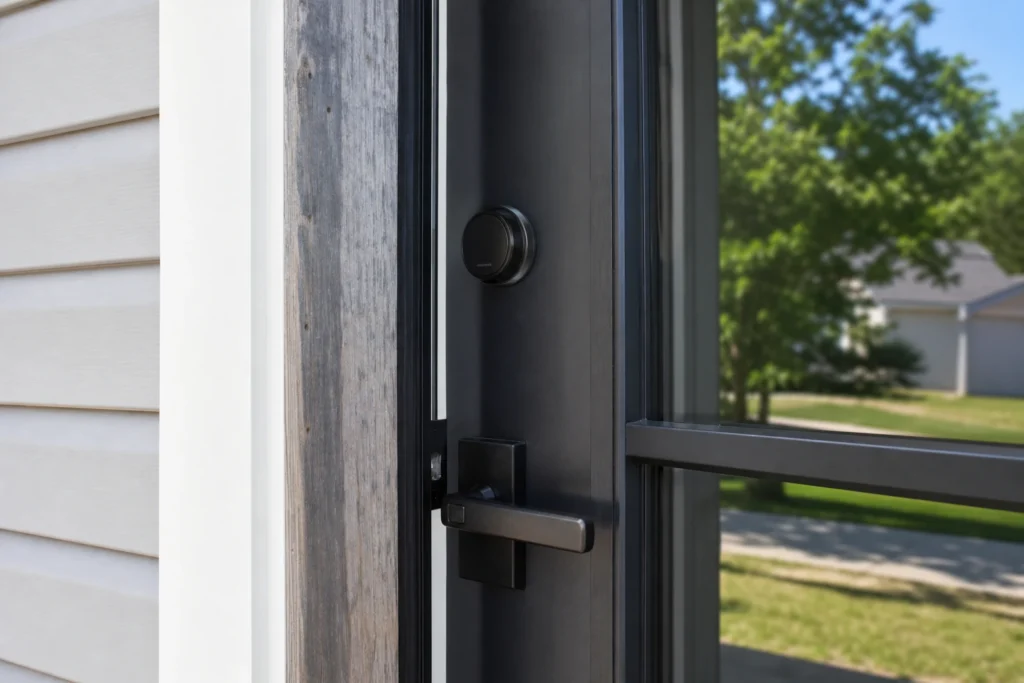
A smart lock pays you back only if it fits your door and the way you hand out keys. In 2026 you really have two paths: keep your existing deadbolt and add a motor that turns it, or replace the deadbolt with a full smart model. The right choice depends on the door’s condition, how you share access, and how much you want to change your hardware.
Retrofit add-on: keep the deadbolt, add the brain
A retrofit sits on the inside and turns your current thumbturn. Your exterior hardware and keyway stay the same, which is great if the handle set matches other doors or you prefer a physical key as a fallback. Install time is fast because you are not drilling, and curb appeal does not change.
The catch is that a retrofit inherits every quirk of the old deadbolt. If the bolt drags, the motor works harder and batteries drain sooner. If the key already feels gritty, electronic control will not fix the underlying alignment. This route makes sense when the deadbolt is smooth, the strike is solid, and you want minimal change with app control, auto-lock, and codes layered on top.
Full smart deadbolt: new hardware, clean slate
A full smart replacement gives you new interior and exterior hardware with integrated electronics. That lets you solve fit and function at the same time, reinforce the strike, and choose keyed or key-free. You also get consistent feel across doors if you plan to match multiple entries.
Because you are swapping the lock, you have to confirm bore size, backset, and door thickness. Most modern doors are a match, but older or custom slabs may need an adapter. The benefit is a fresh cylinder, properly sized bolt, and a clean calibration that tends to be quieter and easier on batteries. If you are tired of a sticky key or want to change finishes, this is usually the better long-term move.
A quick 6-step fit check before you buy
- Measure the bore: it should be about 2 1/8 inches.
- Check backset: most are 2 3/8 or 2 3/4 inches, and your lock should match.
- Test the current deadbolt with the door closed: it should extend fully with two fingers on the thumbturn.
- Look at the strike: solid metal with long screws into the framing is ideal.
- Open and close the door: if the top or latch side rubs, plan to correct alignment.
- Note your preference: do you want a keyway or are you comfortable fully key-free?
If steps 1 to 4 pass cleanly and you want to keep your exterior look, a retrofit is usually fine. If any of those checks show friction or misfit, a full smart deadbolt gives you the chance to correct the door and hardware together.
Setup that actually works day to day
Once the lock is on, the details you choose in the app decide whether daily use feels smooth. Start by calibrating the bolt with the door fully closed, then set one owner code and one guest code you can change without fuss. Enable an auto-lock delay that matches your routine rather than an instant re-lock that fights you during quick trips to the mailbox.
Decide how you will handle lockouts before you have one. A keyed model gives you a metal fallback. A key-free model demands a clear plan such as a stored backup code and phone access shared with a trusted person. For connectivity, Wi-Fi reaches you from anywhere but may reduce battery life; Bluetooth is lighter on batteries and fine for people who are usually close by. If your lock supports a hub, place it within strong signal distance of the door for reliable updates.
What smart lock installation services cover for you
A professional focuses on the parts that quietly make or break the system: straightening the door so the bolt throws cleanly, reinforcing the strike with long screws, centering the latch in the bore, and verifying that the lock calibrates without strain. On the software side, a good walkthrough includes pairing the lock, updating firmware, setting owner and guest access, and showing you how to add or revoke codes without resetting the whole device.
If you want help choosing hardware and getting it fitted right the first time, review our smart lock installation and related options on the Services page. For homeowners planning a broader security refresh, our Residential Locksmith page outlines additional upgrades that pair well with smart locks, like strike reinforcement and rekeying existing cylinders.
Ready to pick a path?
If your current deadbolt is smooth and you like its look, retrofit and move fast. If the door sticks or you want a fresh finish and cleaner operation, replace the deadbolt and start from a solid baseline. If you would like a quick fit check or installation support, reach out through our Contact Us page and tell us which door you are considering.