
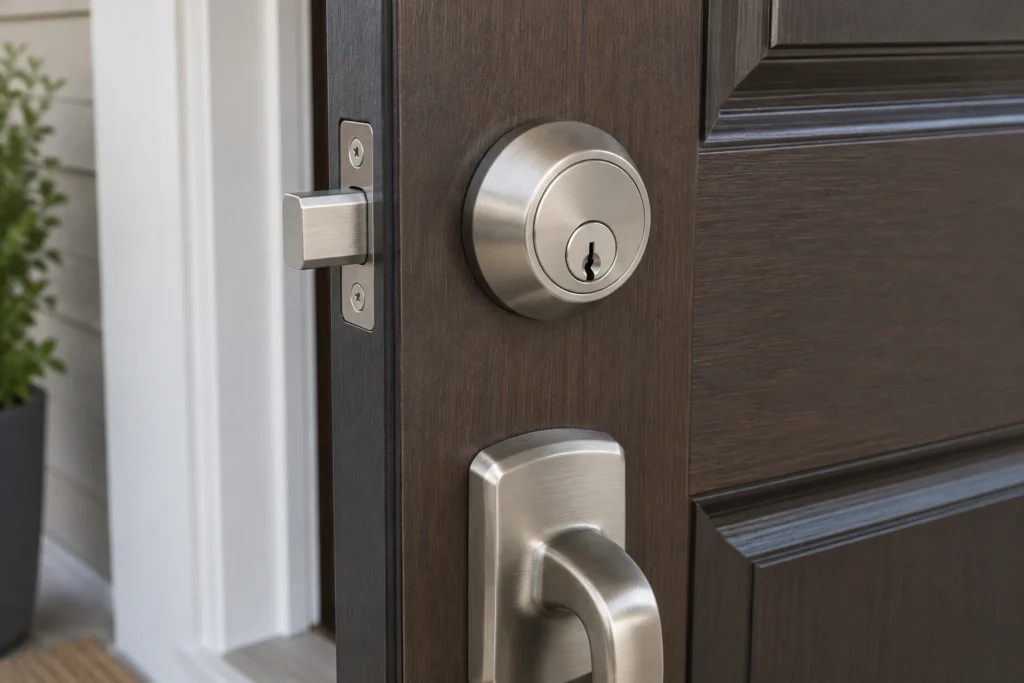
Single-cylinder deadbolts unlock from inside with a thumbturn, so exit stays quick and keyless. Double-cylinder deadbolts require a key on both sides, which may reduce smash-and-reach risks near glass but can block a safe exit if you do not have a key in hand. A third option, the classroom-function deadbolt, is designed to preserve free egress while limiting who can lock or unlock from the corridor side, giving Georgia small businesses and rentals a way to address glass-adjacent concerns without putting an interior key between people and the exit.
If you are choosing or approving locksmith services, start with egress. If the door is part of an exit path, it generally must open from the inside without a key and often in one motion, depending on your occupancy and the Authority Having Jurisdiction. That is why single-cylinder or certain classroom-type functions that remain keyless to exit are the default on many egress doors. Double cylinders may appear to solve a glass problem, but they can create a life-safety problem, so treat them as exceptions that require explicit approval and careful documentation in Georgia.
How each deadbolt behaves on your door
A single-cylinder deadbolt has a keyed exterior and a thumbturn inside. From the public side you need a key. From the inside you turn the thumbturn and you are out, which typically preserves the “keyless to exit” expectation on egress doors. The catch is that adding a separate deadbolt can create two operations to open the door, and many occupancies do not permit that on required exits. Make sure the total door set still releases with the allowed number of operations before you rely on a single-cylinder as a compliant solution.
A double-cylinder deadbolt is keyed both sides, so the inside also needs a key to unlock. Some owners consider it when a door has sidelights or a large vision panel because a thief could break glass and twist an exposed thumbturn. The tradeoff is real. If a key goes missing or a guest cannot find it in an emergency, exit slows or stops, and many Georgia AHJs prohibit this configuration on egress doors.
A classroom-function deadbolt aims to keep exit keyless while controlling how the bolt is set from the corridor side. In practice, that means you still get free egress from the interior, but a key determines when the deadbolt is locked or unlocked toward the public side. It reduces the risk that someone can reach in through broken glass to throw or retract a thumbturn, because interior locking control is limited by design. Models vary by manufacturer, so pair any classroom-type selection with an egress check and AHJ confirmation before you buy.
- Function comparison at a glance:
- Single-cylinder: Key outside, thumbturn inside. Inside stays keyless to exit but may add a second operation on some doors.
- Double-cylinder: Keyed both sides. Can reduce reach-through risk near glass but blocks keyless exit and usually needs AHJ approval.
- Classroom-function: Free egress from inside; locking control managed by key toward the corridor. Designed to address glass-adjacent concerns while preserving interior egress.
Georgia egress first: occupancy, exit paths, and one operation
For Georgia small businesses, assembly spaces, educational uses, and multifamily common areas, doors on the exit route are typically expected to release from the inside without keys, special knowledge, or tight grasping. In many occupancies, a separate deadbolt that requires a second action violates the one-operation rule. If you need deadbolt-level security on an egress door that also has a latch, look at hardware combinations or functions that release in one motion or keep the latch and deadbolt tied together. Even a single-cylinder deadbolt can fail the one-operation requirement if it forces a second action, so verify how the complete door set releases before you approve it.
Use a simple flow to choose the right function. First, decide whether the door is on a required exit path for your space and occupancy. If it is, select hardware that keeps the interior keyless to exit and confirms the allowed number of operations: that often points to a single-cylinder only when one-motion release is preserved, or to an appropriate classroom-type function that preserves free egress while reducing reach-through risk. If the door is not on the exit path, you have more options, but still favor free egress from interior spaces people routinely occupy. In all cases, confirm with your local Authority Having Jurisdiction in Georgia, because they interpret and enforce the model codes and any local amendments.
Real-world Georgia scenarios illustrate the choices. A storefront with narrow sidelights near the lock is often better served by laminated glazing, a higher security exterior cylinder, or a classroom-type deadbolt that avoids an exposed thumbturn, rather than a double-cylinder that traps occupants without a key. An office corridor door that is part of an exit route typically needs to remain keyless to exit and single-operation, so avoid layering a separate deadbolt unless the combined hardware still meets that requirement. In multifamily and short-term rental main egress doors, prioritize one-motion, keyless exit from the dwelling side and only add functions that do not complicate escape for guests unfamiliar with the lock.
Near-glass risks and safer mitigations
Owners reach for double cylinders to prevent a smash-and-reach attack, but the life-safety downside is steep, and Georgia AHJs often disallow keyed interior egress on required exits. Treat glass-adjacent risk as a design problem to solve without introducing a key dependency on the interior. When you need to control reach, focus on reducing access to the control, strengthening the opening, or both.
Security improvements that preserve free egress include laminated or reinforced glazing, protective screens or grilles that do not impede escape, moving or shrouding the interior control so it cannot be reached through a broken lite, and using a higher security exterior cylinder that resists picking and drilling. Security film can help retain shards and slow casual forced entry, but it does not make standard glass unbreakable; determined attacks, sharp tools, or sufficient impact can still create an opening. A classroom-type deadbolt can also reduce thumbturn exposure by controlling locking with a key from the corridor side while keeping the interior side keyless to exit. Where a deadbolt is desired on an egress door that also has a latch, consider hardware that ties the release together so a single interior motion unlocks the set.
Rekeying, replacement, and managing the work
Rekeying keeps your existing hardware and changes which keys operate it. It is fast and budget friendly when the lock is healthy and the current function is still right for the door and occupancy. If the goal is to change the way the door operates for egress or to upgrade physical security beyond what the current lock can deliver, plan on replacing the hardware instead. That decision turns on how the door must operate from each side, the presence of nearby glass, and whether the existing prep matches the new hardware you are considering.
Manage the project with clarity and documentation. Ask your provider to state in writing which function will be installed and why it is appropriate for the door, confirm that the inside remains keyless to exit and within the allowed number of operations, and explain how any glass-adjacent risk is addressed without blocking escape. Request clear photos before and after from both sides that show the hardware and any nearby glazing, along with part numbers and notes on keying. On urgent work, set a not-to-exceed amount before dispatch, define when destructive entry is allowed, and require a short completion note you can show a landlord, HOA, or inspector.
Putting it together for Georgia small businesses and rentals
Choosing between single-, double-, and classroom-function deadbolts in Georgia starts with egress. On required exits, keep the interior keyless and within the allowed number of operations, and assume a separate deadbolt may not comply unless it releases in one motion with the latch. Use a single-cylinder only where that remains true, consider a classroom-type function to mitigate glass-adjacent reach without sacrificing exit, and reserve double cylinders for rare cases your AHJ explicitly approves in writing. Where the door is not on an exit path, you still want free interior egress and controls that are intuitive for employees, tenants, and guests.
For related details, review 7 Common Door Lock Problems and How to Fix Them and Are Keyless Door Locks Worth It? Pros, Cons, and Security Tips.
Verify your choice with the Authority Having Jurisdiction before you install. Send a short package to your local fire marshal or building department that includes the occupancy type, whether the door is on a required exit route, photos of the opening and any adjacent glass, and the exact hardware function you plan to use. Ask for written confirmation and keep it on file with your completion photos and invoice so you can answer future questions quickly. As a local, family-run locksmith in Alpharetta serving residential and commercial needs across Georgia, we help small businesses, property managers, landlords, and rental operators match hardware to security goals and egress rules, then document the result so you can feel confident at inspections and turnovers.